
Notes on Platner
He's a problem, but he's not *the* problem


All-electric zero-emission Freightliner Cascadia 2025, by Daimler Truck North America, via Beverage Industry.
Over the weekend, presumptive Maine Democratic Senate candidate Graham Platner released his “Take Back American Power“ energy plan, attacking the ferocious rise in energy prices that Americans including Mainers have been suffering with over the last couple of years for heating, driving, and running farm equipment: he offers to cut prices by eliminating the federal gas and diesel tax; subjecting oil companies to the windfall profits tax proposed by the Biden administration in 2022 and currently pushed under the leadership of Sen. Sheldon Whitehouse and Rep. Ro Khanna, which is supposed to encourage them to stop price gouging; and inviting states to freeze or lower their electrical utility rates in return for money to finance low-cost clean-energy infrastructure projects (carrying on the legacy of the Biden Infrastructure and Jobs Act of 2021).
And a bunch of other stuff, including a genuinely socialist-sounding supplement to the Biden Energy Infrastructure Reinvestment Program but bypassing the private capital, which
would issue debt backed by the full faith and credit of the federal government, and partner with state lending authorities to provide cheap capital directly to utilities, rural electric co-operatives, public energy authorities, and other developers of low-risk clean energy projects. Developers of fully permitted, shovel-ready transmission lines or offshore wind projects, for example, could tap the Infrastructure Fund at rates close to the federal funds benchmark – considerably lower than their borrowing costs on private debt and equity markets – and pass tens of billions in savings on to ratepayers.
That’s an Elizabeth Warren proposal, and the most interesting thing in the list to me, though I’m pretty enthusiastic about the windfall profits tax (per barrel of oil, charging 50% of the difference between the prices of the current year and the previous year), which has a realistic prospect of passing if we elect a Democratic Congress in November, which is of course more likely if Platner takes the Maine seat from Concerned Susan Collins.
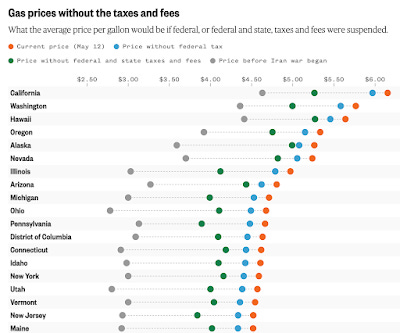
The canceling of the federal gas and diesel tax, in contrast, seems more than a bit off target, given the tax’s aim of discouraging fossil fuel use while funding clean energy projects. Whitehouse-Khanna have a better proposal with their version of the windfall profits tax, offering cash rebates to everybody (including nondrivers). Besides, the federal gas tax is apparently a pretty modest part of the cost of driving, substantially less than state and local gas taxes, to say nothing of what drivers have been paying on top of that for Trump’s Iran war, per this NBC report (whole chart at the link):
Don’t forget that for farmers and independent truckers the gas price including tax is passed on to customers anyway. But really, the idea is that they should all go electric, sooner rather than later, as electrics get cheaper and charging networks get bigger. But my main instinct was to see it as a harmless bit or popularism, to convince Maine voters that he feels their pain.

All-electric combine harvester by Terafield, cheaper to operate than a comparable diesel machine, reduces TCO by up to 16 % in 5 years.
But then yesterday Trump told CBS that he planned to “suspend” the gas tax “for a period of time”, and my neighborhood of the internet exploded—not against Trump, but against Platner:
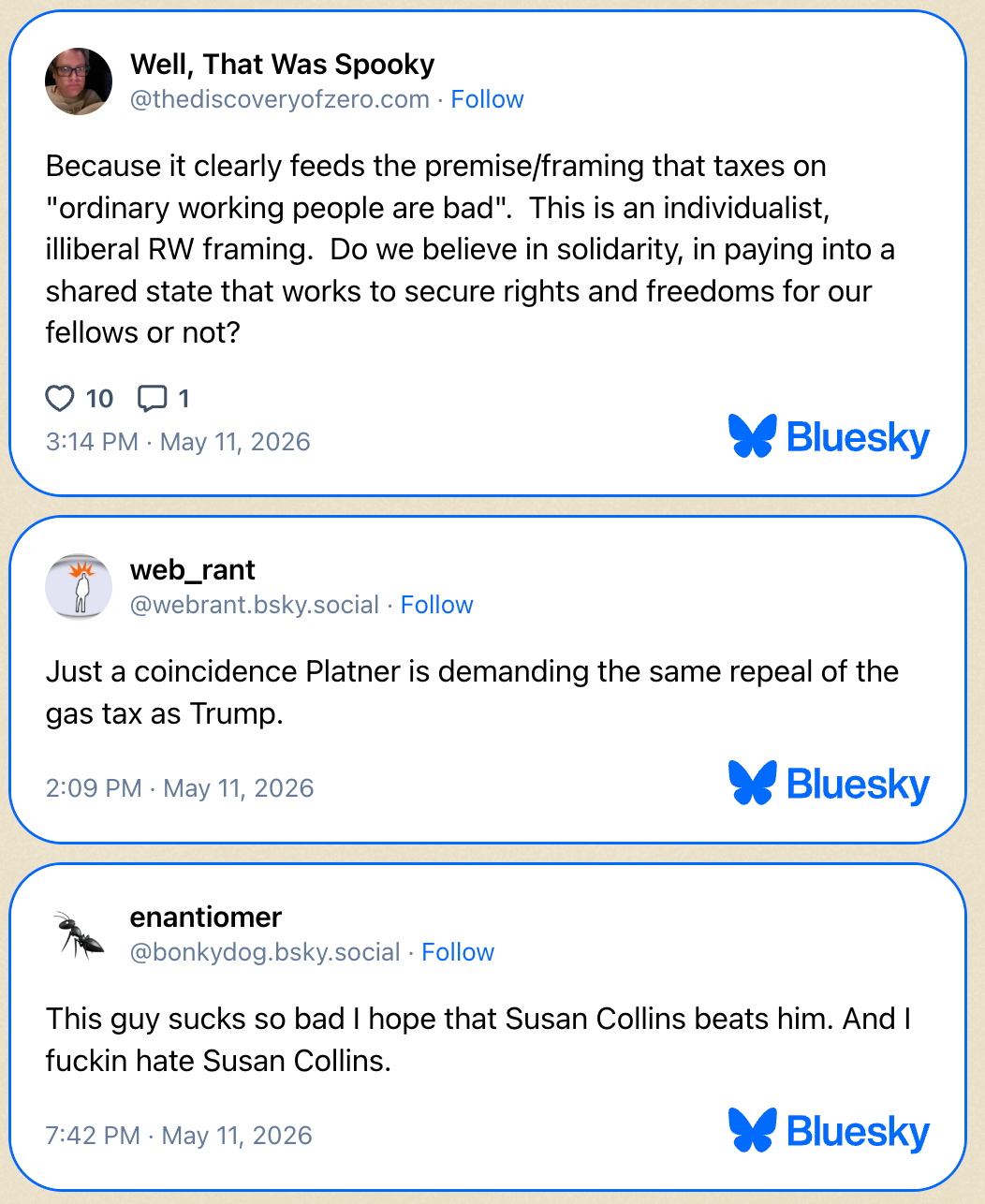
And there you have it. When the project of Democrats taking the Senate crucially depends on this Democrat taking Maine, they’re talking themselves into being unable to vote for him, like the ones who talked themselves into being unable to vote for Kamala Harris two years ago because they decided she favored genocide and couldn’t be persuaded otherwise.
I had a pretty bad attitude toward Platner myself from the start of the campaign, reading about him and listening to him. Not that I ever credited the Nazi allegation in particular—the story he tells about getting the tattoo is stupid enough to be true (and I can say I have some serious experience of my own of being young and making really bad decisions, though mine were mostly involved with avoiding the military), especially the way it was discovered back in October, when he was videoed in a shirtless lip-synching performance at his brother’s wedding, on video, which really happened; while his former campaign director’s statement seemed to come from a different planet:
“Platner prides himself on his extensive knowledge of military history,” McDonald said. “While he may not have known what his tattoo meant when he selected the image, it is not plausible he remained ignorant of its meaning all these years.”
Lots of people pride themselves on their knowledge of military history, but that doesn’t mean they have it. Read that way, this is a funny story about Platner thinking he knows it all and then getting punished when people believe him.
Also, proof that it’s possible, if not exactly plausible, in a genuine Reddit post from andy5000 asking “Coverup advice or what the hell is a Totenkopf?” some time in 2024:
Many years ago, I happened to be in a tattoo shop during a promotion. Roll a d100, pay $100 for a piece of flash from a book with 100 options. I roll the die, lands on a skull and crossbones. I think “fuck yeah” pirates are cool, skulls are cool. I get the jammer on the back of my arm, artist does solid work, I go home happy with my new tattoo. Fast forward to last summer. I’m at work, and one of the guys says something like “bro! is that a nazi tattoo!?” I was bit stunned and offended, which he only found more funny. He had a point, it looks pretty close to a symbol used by the nazi SS.
For the record, I’m not, nor have ever been a nazi. And it may be radical to say, but I think nazi lives don’t matter. Anyways I wore this tattoo for years and no one ever said anything. So I kinda chalked it up to this guy being an asshole trying(and succeeding) to fuck with me. Fast forward again to last week. A totally different person at work asks me “What does that tattoo mean? Cuz it kinda looks like…”
So here I am, soliciting advice on a cover up or adjustment to this thing. As long as no one asks me again if I’m a nazi, I’ll be happy with the change. But I wonder if Reddit has any cool or creative ideas. I have a good relationship with the artist (he’s currently working on my back piece) and intend to ask him to do the adjustment.
So Platner discovered he looked like a Nazi in the same way and covered it up just like andy, except he learned it at the most humiliating moment possible, same time as everybody in Maine did, after he announced his Senate candidacy, from the quickly viral video. That’s funny too.
As is the story of how he went to work for Blackwater’s mercenaries after dropping out of George Washington University for the second time in 2018. It wasn’t for Blackwater’s mercenaries but the State Department contracts of the successor company, Constellis, not owne by Erik Prince, and his job was providing security for the US ambasssdor in Kabul, who didn’t need security since, as he later explained, “We were barely leaving the Green Zone… All I did was lift weights and play video games. I got huge and I played a lot of Far Cry.” So he went back to Maine after six months and finally started taking his PTSD therapy seriously.
My own beef with Platner was maybe kind of petty and personalistic, I’m afraid: the way he seemed to be posing as a member of what journalists (as opposed to sociologists or Marxists or both) refer to as the “working class”—a beefy fairhaired white guy with a very big voice and salty vocabulary—when his biography was in fact that of a troubled child of privilege, with the restaurateur mother and the attorney father and the famous architect grandfather, privately educated, who ran away on an impulse to join the Marines, did tours in Iraq but was unable to finish college, and at last ended up settled as a gentleman oyster farmer, supplying his mom’s place with the luscious bivalve, and trotting around town as harbormaster and chair of the planning board. But he’s “central casting”, as Trump would say, for the effort to pick up disillusioned Trump voters with his contempt for the establishment and tough-guy looks. Whereas what I mean by “working class” is people forced to sell their labor because they have nothing else to live from.
Of course I still wanted him to win, assuming he was going to win the primary (and I didn’t think much of his main rival, Governor Janet Mills, trying to begin a Senate career at the age of 77, while the other candidate, David Costello, has been so thoroughly ghosted by national media that it was only very recently I learned his name—seems like a good guy who would make a perfectly good senator, but as he asked local media a couple of weeks ago, “How do I become known?”). I want to see a Democratic majority in the Senate a year from now undoing the horrors wrought by the Trump admimistration. Whatever Platner might fail to do, Collins will fail worse, as she’s shown through her career.
What I finally understood is that it’s not Platner’s fault. It’s the packaging, which he’s not responsible for, and in a certain sense it’s not even the packagers’ fault—in particular Morris Katz, a 26-year-old strategist according to NYTimes but 28 or by now even 29 per Vanity Fair, who has worked not only for Zohran Mamdani (yay!) but also John Fetterman (uh-oh!). It’s systemic—the way these things happen—the corporate selection of a stereotype branding image—and Graham Platner doesn’t do it. He can do a real antiwar interview (with Ben Rhodes, gift link here) that’s not America First posing, and talk about the (sometimes) goodness of government in terms of how it pulled him out of PTSD (even as government was responsible for the war in which he got it):
I received therapy for it. I’ve gone to therapy for years, and frankly, it’s what has turned me into a much happier, more engaged and fulfilled person,” Platner said in the interview. “But I struggled. I mean, when I got out of the Army in 2012, I struggled for a number of years with my place in society, with undiagnosed PTSD. I didn’t really start getting treatment until 2017. So it was a hard road for a bit. But if it wasn’t for the help I got from the VA, I would not be where I am today, and I’m incredibly grateful for it.”
To me that’s what the story is really about: therapy, not just for PTSD but for the toxic masculinity that drove him from a comfortable upper class life into the Marine Corps in the first place, when he should have been going to college, and the combat addiction foreshadowed in his high school radicalism (not necessarily as much for ideological thrills as getting into fights with conservative jock Maine classmates).
It’s a very long and difficult path, with lots of room for backsliding and probably being less than honest about your past, and making an occasional fool of yourself as well. But I think it’s been working, and I’m ready to see him in the Senate, bringing a Democratic voice against wars without the mistakes so many make, as he told Rhodes:
He decried party leaders who focus on President Trump’s failure to seek congressional authorization: “There’s a big difference between saying the war shouldn’t be happening because it is bad and saying the war shouldn’t be happening because they didn’t ask permission.” He lamented the tendency to leaven statements against the war with lengthy condemnations of the Iranian regime that “lay the ideological and propaganda basis” for what Mr. Trump is doing. He also noted rightly that many Democrats have been longtime hawks on Iran, supporters of the Israeli government and allies with pro-war groups such as AIPAC.
His own message isn’t so mediated:
an unflinching disgust for the forever war we have waged since 9/11. “Nobody is going to be able to convince me that what I did in Iraq and Afghanistan did anything for the people of Sullivan, Maine,” he told me, punctuating his point with an obscenity. “I don’t want other young Americans to go through what I’ve been through. And I don’t want to send other young Americans to inflict the horror that I had to inflict on people.”
If all that weren’t enough, I saw elsewhere today that some Mills dead-enders are going to pull a PUMA and vote for Collins because Mills dropping out because she couldn’t raise money despite being well known and having the backing of Schumer and the Dem establishment… is all about the Highly Experienced Woman being passed over for the Unqualified Male. Sigh. We’re just not going to get nice things, are we?
Thanks for doing the backgrounding stuff.
People. Whatcha gonna do...
[insert big sigh sound]